
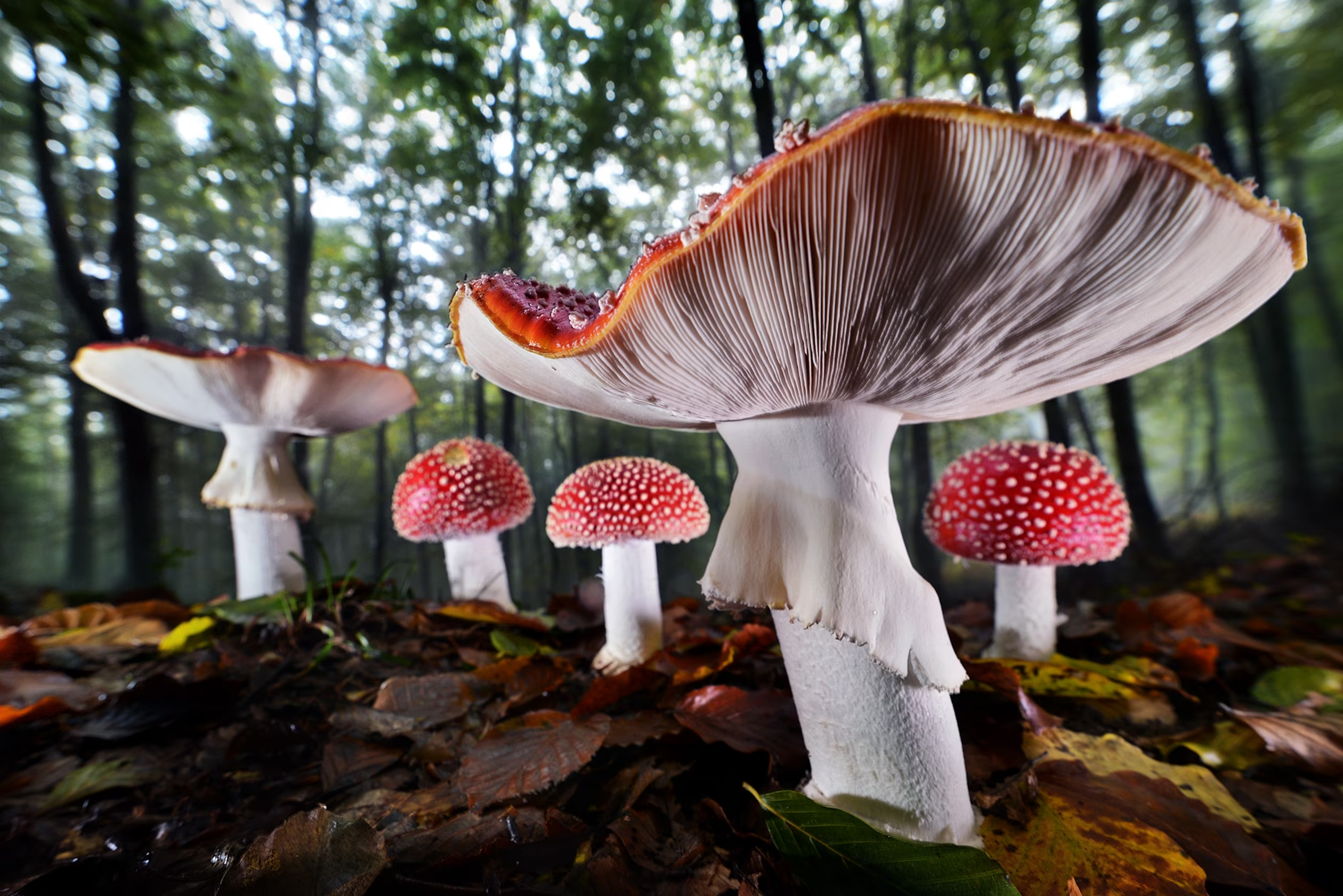
Fairy rings
I’ve always had a bit of fascination with fantasy and science fiction. That’s probably not surprising given the name of my jewelry business! Today I read this National Geographic article about mushrooms and the science behind mycelium (or mushroom rings), and I thought I would share some of the interesting bits here.
First, a bit of the science:
… contrary to popular belief, fairy rings are not the result of fairies, witches, or other supernatural beings dancing and cavorting in circles. They form when a fungal spore grows into a mycelium—the underground threads that form a single fungal organism—and sends out a subterranean network of tubular threads called hyphae. The hyphae that make up the mycelium grow evenly in all directions and then produce a near-perfect circle of “fruiting bodies”—mushrooms—above ground. When the central mycelium eventually dies out, the edges keep growing, and the ring gets wider every year. Fairy rings are found mostly on grasslands, but can also be spotted in woodlands, living in symbiosis with trees.
Many cultures view mushrooms as eerily uncanny; they erupt in odd places and coalesce into weird shapes; they don’t grow and develop the same way as fruits, vegetables, or other plants. Their potential poisonousness adds to this malevolent reputation. While it’s wise for cultures to be wary of ingesting unknown fungi, mushrooms are a key part of nature. “Fungi are nature’s great recyclers, and they beautifully represent the interconnected cycles of decay, regeneration, and rebirth that underpin our world,” observes Dillon.
And the folklore:
Since fairies are the quintessential supernatural agents in the Gaelic world, they would almost inevitably be associated with strange ‘unnatural’ or inexplicable phenomena in the landscape,” explains Barbara Hillers, associate professor of folklore at Indiana University Bloomington. “So it makes complete sense that mushroom rings would be associated with fairies as a kind of etiological explanatory device.”
While fairy ring folklore may be even older, we can date it to at least the 12th century with the Middle English term elferingewort, or elf-ring. Fairy rings themselves can live for hundreds of years, with the oldest found in Belfort, France, measuring nearly a half-mile in diameter and thought to be 700 years old.
Zotti asserts much of what we know about the formation of fairy rings originated in folklore. And some superstitions are rooted in truth.
And later in the article:
Fairies are also frequently connected with mushrooms in folklore, notesJonny Dillon, an archivist at the Irish National Folklore Collection at University College Dublin, and not in a positive way. “Fungi have long been looked on with a culture of suspicion and skepticism, being popularly associated with the devil, púca, or fairy.”
I enjoyed the article quite a bit – I thought the author did a nice job weaving together the science and the folklore. I’m very interested in the ways our ecosystem flourishes in spite of all the damage done by humans. And, there is nothing wrong in believing in a bit of magic!
1 thought on “Fairy rings”